
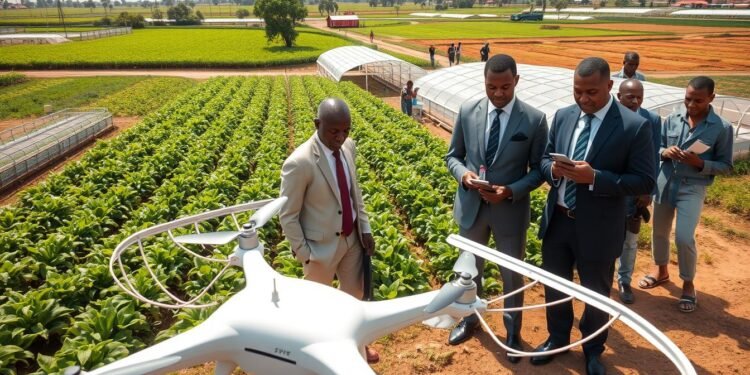
What if the biggest opportunity for growth in Nigeria’s fields isn’t found in the soil, but in the smartphone?
This question drives a significant transformation. Stakeholders across the farming landscape are actively integrating digital tools into long-held practices.
The agriculture industry is vast and complex. Its future remains bright, fueled by population growth and evolving diets.
Nigeria’s evolution is part of a worldwide shift toward modernized production. The goal is to scale local output to meet rising domestic needs.
By understanding this trajectory, investors and leaders can forge better strategies. This report offers a detailed look at the current scale and the potential for progress.
Key Takeaways
- Nigeria’s farming landscape is undergoing a major digital transformation.
- Traditional practices are being enhanced with new technological tools.
- Scaling production is critical to support a growing population.
- The country is positioned to leverage innovation for greater economic output.
- Technological advancement is key to improving long-term food security.
- This analysis examines the present conditions and future potential of this space.
Introduction to Nigeria’s Agritech Sector
The need to feed a booming urban populace is accelerating the adoption of smart farming solutions. This pressure comes from rapid population growth and changing dietary preferences. More efficient production systems are now a national imperative.
Overview of Agritech Developments
Digital tools are bridging a crucial gap. They connect time-honored farming methods with modern industrial needs. This integration is essential for scaling output to meet domestic demand.
Relevance to Nigeria’s Economic Landscape
Technology in farming is a strategic pillar for economic diversification. Moving beyond oil dependency, both government and private investors are prioritizing this space. Their goal is to enhance crop yields and ensure long-term food security.
Understanding this evolving sector is critical for all stakeholders. It presents significant opportunities for growth and stability.
Technology and Innovation in Agritech
Beyond simple mechanization, today’s farming tools are becoming intelligent partners in the field. This shift provides operators with unprecedented control and insight.
Precision Farming and Autonomous Robotics
The use of precision farming tools allows for optimized resource application. This significantly cuts waste and improves overall farm efficiency.
Autonomous robotics are now affordable. Units equipped with computer vision fell below USD 50,000 in 2025. This enables mid-sized farms to adopt automation.
Robots like the Aigen Element Gen2 can cover up to 20 acres. They provide scalable solutions for modern operations.
Edge-AI and On-Device Analytics Applications
Edge-AI technology enables on-device analytics. Drones and ground robots can classify weeds or detect disease locally.
They do not need constant cloud connectivity. Low-power neural processing units deliver over 250 TOPS while using less than 15 watts.
By processing data on the device, farmers in areas with poor infrastructure gain advanced computer vision. They get real-time field insights.
The industry is adopting these high-tech tools to tackle labor shortages. They ensure precision is maintained throughout the growing season.
Understanding the African agritech market size
The valuation of smart farming initiatives across Africa points to a future shaped by digital tools and data. This financial scale reflects a continent embracing innovation to boost its primary economic sector.
Market Growth Trends and Forecasts
Projections show strong expansion for technology in farming. Advancements in AI and robotics are set to accelerate this trajectory.
Efficiency gains from these tools directly increase productivity and production. This leads to a more robust and resilient agricultural system.
Future forecasts suggest integrated systems will become the norm.
Key Drivers and Demand Influencers
Climate change is a major pressure point. Droughts and unpredictable rainfall threaten crop yields and stability.
The urgent need for food security is pushing investment into sustainable practices. Rising demand for high-quality produce also fuels sector growth.
These factors combine to create a powerful impetus for change. They guide where capital and innovation flow.
Market Landscape and Investment Opportunities
Strategic capital deployment is accelerating the integration of smart systems into traditional farming. This shift creates a dynamic environment for stakeholders seeking growth.
The farming technology industry attracts significant investment. Investors see long-term value in digitizing agricultural supply chains.
Emerging Investment Areas in Agritech
Capital flows toward AI-driven pest detection and autonomous machinery. These tools deliver high value to mid-sized and large operations.
Leading companies like AGCO advance their “Farmer-First” strategy. They broaden precision technology offerings through portfolios like PTx.
Subscription models help farmers scale commitments based on yield benefits. This approach makes advanced tools more accessible.
Regulatory and Policy Influences
Government policies increasingly provide financial support for smart-farm initiatives. Grant programs are active in North America, Europe, China, and India.
These programs accelerate adoption of modern technologies. Navigating the evolving regulatory sector is key for market entry.
Policies regarding data and technology use continue to develop. Understanding this landscape is crucial for successful implementation.
Challenges in the Agritech Industry
Deploying advanced farming tools often hits a wall where digital networks end and rural reality begins. One of the primary challenges is the lack of robust rural infrastructure. About 1.8 billion people live in areas with poor internet.
This limits real-time cloud-based analytics. Another growing issue involves data security. Many growers are uneasy about third parties accessing their private yield maps.
Complex data sovereignty laws create further hurdles. For example, China’s 2021 law requires local storage of farm information. Multinational firms must comply to serve that market.
High latency in remote zones forces vendors to build hybrid systems. These mixes of cloud and edge computing keep tools functional. Solving these infrastructure and trust challenges is vital. It ensures the benefits of modern farming reach every operator.
Potential Impact of Global Trends on Local Markets
Recent worldwide crises expose the fragile links in our food systems. Local producers must now navigate disruptions that start thousands of miles away.
Effects of Pandemic and Conflicts on Supply Chains
The COVID-19 lockdowns stalled global supply chains. Demand for many agricultural products fell sharply.
Later, the war in Ukraine cut exports of key crops. This strained the global market for staples like wheat.
Climate change makes these shocks worse. Extreme weather threatens stable food production.
Trade route problems cause price swings. This volatility hurts local budgets and planning.
Building stronger local supply chains is now a priority. Investing in technology can shield agriculture from external change.
The goal is a resilient system that ensures food security for all.
Regional Analytics and Future Outlook
Benchmarking against regional leaders offers a clear path for improving Nigeria’s farming outcomes. Examining progress in other nations provides a strategic blueprint for stakeholders.
Nigeria’s Market Specifics and Production Efficiency
Local efforts focus on boosting crop yields through better water management. Improving production efficiency is a top priority for the nation’s agricultural sector.
The goal is to significantly raise overall farm productivity. This will help meet domestic demand and create export potential.
Comparative Insights with Global Agritech Markets
South Africa is a key region for smart-farm pilots. IBM-led irrigation scheduling projects there demonstrate advanced technology use.
Other countries, like Brazil, integrate AI into sugarcane chains to meet strict export standards. These examples show high production efficiency in action.
Analyzing the market in South Africa reveals best practices for scaling operations. The future outlook for Nigeria depends on adopting similar successful strategies.
Continued investment in South Africa and neighboring countries drives regional sector growth. Their success provides a tangible roadmap for local advancement.
Competitive Landscape and Strategic Moves
The race to dominate the future of farming is intensifying. Established giants and nimble startups are vying for influence and market share.
This rivalry pushes the entire industry forward. It accelerates the adoption of cutting-edge technologies.
Leading Companies and Innovations in Agritech
Major companies like John Deere are a driving force. They integrate precision technologies directly into their machinery products.
Big Data and Analytics tools now account for a significant part of the sector’s valuation. Robotics and Automation are projected to grow at a high rate.
These solutions provide immense value by boosting productivity. This is crucial for food security.
Strategies for Sustained Growth and Efficiency
The core strategy for many firms involves serving smallholder farmers. India’s massive digitization plan is a key example.
Providing accessible data and support to these growers ensures equitable benefits. Sustainability is another central pillar.
Companies develop systems that optimize water use and minimize environmental impact. This focus on efficiency and sustainability defines the long-term strategy for growth in agriculture.
Ultimately, companies that build user-friendly, resilient solutions will lead. They will best serve farmers facing a changing climate.
Conclusion
The journey toward a more productive and resilient farming system in Nigeria is now firmly underway. The future of its agricultural sector is bright, but it demands continued investment in digital tools and supporting infrastructure.
Sustained growth will depend on successfully integrating precision technologies. Data-driven decision-making processes are essential for enhancing efficiency across the market.
The focus must remain on improving productivity and ensuring all farmers have access to modern innovations. Addressing connectivity and data security challenges is paramount to unlocking the local market‘s full potential.
By learning from global trends and regional successes, Nigeria can position itself for leadership. Continued collaboration between government and private companies will be the catalyst for long-term agricultural transformation and food security.