
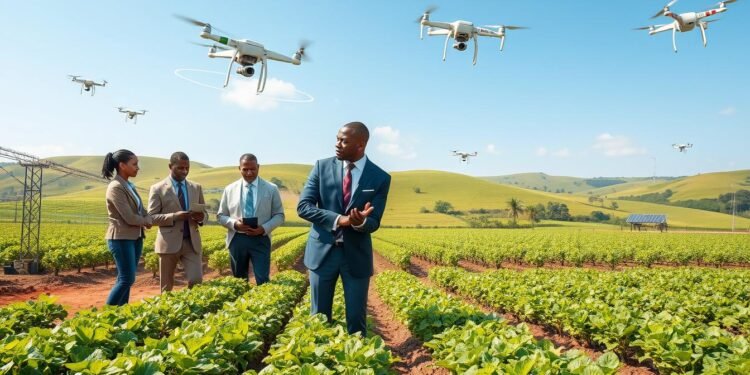
What if the key to unlocking Africa’s economic future isn’t found in oil or minerals, but in the hands of its farmers using smartphone apps?
This question lies at the heart of a major shift. The growth of the technology-driven agricultural sector is a critical indicator for economic development. This is especially true in nations like Nigeria.
Reports show this industry is evolving at a rapid pace. It aims to meet the needs of a growing population. The transformation is happening now.
Our examination focuses on the current state of this dynamic landscape. We provide actionable insights for business leaders, investors, and policymakers. Nigeria serves as a primary case study.
Understanding how digital tools impact local agricultural output is crucial. Stakeholders are turning to data-driven solutions. They seek to address the complex challenges of modern food production systems.
Key Takeaways
- The agritech sector is a vital indicator for continental economic growth.
- Nigeria is a primary focus for understanding digital impact on agriculture.
- Industry evolution is accelerating to meet demographic demands.
- Stakeholders increasingly rely on data-driven approaches for solutions.
- Digital tools are transforming traditional food production systems.
- Understanding this landscape provides actionable insights for investors and entrepreneurs.
- Local agricultural output is directly influenced by technological adoption.
Market Overview and Current Trends
A steady growth trajectory is set for the coming years, blending tradition with cutting-edge tools. The sector remains a cornerstone of economic stability. Reports project a compound annual growth rate near 2.85% from 2025 to 2029.
Understanding the Regional Landscape
Regional food security is a powerful force shaping this overview. Southern Africa, for instance, relies heavily on one nation for staple crops. This creates a unique supply chain landscape.
Commercial farms and smallholder farmers together form the backbone of local food supply. Their combined output is vital for GDP and rural community stability across many regions.
Key Drivers Influencing Growth
The rapid evolution of digital platforms is a primary driver. Biotechnology advances also signal a new era for food systems by 2026.
These innovations address core challenges in modern farming. They help balance productivity with sustainable practices. This dynamic shift defines the current growth phase.
African agritech market size: In-depth Analysis
The financial metrics behind technology-driven agriculture tell a compelling story of rapid scaling and high potential.
This analysis moves beyond surface trends to examine concrete figures that define the sector’s current scale and trajectory.
Historical Data and Current Statistics
Recent valuations offer a clear snapshot. The South Africa AgriTech and Precision Farming sector is currently valued at USD 1.1 billion.
This reflects substantial adoption of advanced tools. Meanwhile, the broader agriculture analytics space for the region is set for a major leap.
It is anticipated to rise from USD 1096.70 million in 2024 to over USD 4203.18 million by 2033.
South Africa’s overall agriculture sector shows similar vigor. It is forecast to reach USD 26.26 billion by 2032.
Implications for Future Growth
These numbers signal strong investor confidence and sector maturity. The export value for the continent’s goods is expected to hit roughly USD 20.5 billion in 2025.
This growth, however, must address persistent challenges. Over 60% of smallholder farmers face inefficiencies in input use.
Precision tools directly tackle this issue, creating a massive opportunity for solutions that boost productivity and sustainability.
Innovative Agritech Solutions Driving Growth
Digital tools are revolutionizing how crops are grown and managed. This leads to unprecedented efficiency gains.
According to the African Development Bank, modern solutions could boost yields by up to 30%. They can also cut post-harvest waste in half. This potential is driving significant growth.
Precision Farming and IoT Integration
Precision agriculture uses satellite imagery and IoT sensors. These tools optimize water and fertilizer use.
In regions like South Africa’s Western Cape, many farmers already rely on this technology. Platforms like Hello Tractor are key examples.
They use IoT to let smallholders rent machinery as needed. This democratizes access and boosts overall productivity.
AI and Data-Driven Decision Making
Artificial intelligence and data analytics empower farmers to monitor crop health in real time. They enable precise optimization of inputs.
Automation is also expanding rapidly. Robotic harvesters and AI-driven sorting systems are now in use. These technologies actively reduce labor costs and minimize losses after harvest.
The Role of Government and Policy Initiatives
Governments hold a pivotal key to accelerating the adoption of digital farming technologies. Their actions set the stage for widespread change.
Strategic frameworks and direct support are crucial for modernizing the agriculture sector. This creates a stable environment for growth.
Regulatory Framework and Support
The African Union’s ten-year CAADP strategy aims to boost agri-food output by 45% by 2035. This is a bold continental commitment.
Yet, many nations still miss the target of allocating 10% of public spending to agriculture. National efforts are trying to close this gap.
Egypt offers subsidies for digital farm systems. Ghana and Rwanda run national digital strategy plans.
Investment in Infrastructure and Research
Public investment drives long-term development. The CAADP plan seeks to mobilize USD 100 billion.
This funding encourages private sector participation across the value chain. It focuses on building roads, storage, and internet access.
Research into climate-resilient crops also gets a boost. Such support from the government ensures solutions are sustainable and scalable.
Impact of Climate Change on Sustainable Farming
Sustainable farming is no longer just an ideal. It’s a necessary response to a changing climate. Rising temperatures and unpredictable rains threaten stable food production.
This environmental pressure makes resilient practices essential for the future of agriculture.
Climate-Smart Agricultural Practices
Climate-smart farming provides the essential toolkit. Drought-resistant seeds and integrated pest management maintain yields in arid conditions.
Water scarcity is a critical challenge. Over 40% of arable land in some regions suffers from salinity and stress.
Irrigation can use over 80% of freshwater. This makes precision irrigation systems a top priority for sustainability.
Programs like the African Development Bank’s TAAT show scalable success. They have distributed improved crop varieties to millions of farmers.
This boosts production and resilience across many countries. Solar-powered irrigation and bio-fertilizers also help.
They improve soil health while reducing the environmental footprint of agriculture. These practices are key to adapting to climate change.
Challenges and Opportunities in the Agritech Sector
Two parallel stories unfold in the push to modernize agriculture. One is of technological promise, the other of access and awareness gaps.
This duality defines the current landscape. It presents both significant hurdles and clear paths forward for the industry.
Infrastructure and Digital Gaps
Connectivity remains a primary barrier. In Sub-Saharan Africa, less than 40% of the rural population has regular high-speed internet access.
This digital divide limits the reach of modern tools. In nations where farming is a major economic driver, the problem is acute.
Poor network coverage in countries like Ethiopia and Malawi hampers IoT systems. These systems are crucial for efficient farm management.
Bridging the Knowledge and Skills Divide
Awareness is another major challenge. Over 65% of surveyed farmers in Nigeria and Tanzania were unaware of available digital tools.
Formal training is scarce. Only 18% of smallholder farmers in Ethiopia had received training on digital agriculture technologies.
Initiatives are working to close this skills gap. The Alliance for a Green Revolution in Africa runs education campaigns.
These programs showcase how analytics tools can directly improve farm profitability. They turn awareness into practical action.
Investment Trends and Startup Ecosystem in Agritech
A vibrant ecosystem of innovators is attracting significant financial backing to solve age-old farming problems. This capital influx signals strong confidence in technology’s potential to reshape food systems.
Funding Opportunities and Venture Capital
Venture capital is increasingly focused on the agricultural technology sector. Strategic funds from around the world are deploying capital to support promising companies.
For example, the Public Investment Fund in Saudi Arabia allocated USD 150 million in 2023. This investment targets startups working on food self-sufficiency solutions.
Showcasing Leading Agritech Startups
Several pioneering startups demonstrate the sector’s value. Apollo Agriculture uses machine learning to assess creditworthiness for Kenyan smallholders.
It provides bundled services like seeds and fertilizer. Thrive Agric connects Nigerian farmers to inputs, finance, and markets through digital platforms.
BioBuu promotes circular practices by converting food waste into animal feed. Selina Wamucii uses USSD technology to bridge the digital divide for rural producers.
These companies show how smart investment creates tangible benefits for farmers. They deliver essential services that improve economic standing.
The Future of Agritech in Nigeria and Beyond
Looking ahead, the integration of advanced technologies promises to redefine agricultural practices across Nigeria and the wider continent. This evolution is critical for meeting the needs of a surging population and ensuring stable food supplies.
Growth Forecasts and Market Predictions
The continent holds 65% of the world’s total arable land. This vast resource offers immense potential for sustainable growth and global food security leadership.
As the population expands, demand will rise sharply. Digital tools are expected to boost productivity and support smallholder farmers. Treating agriculture as a business drives prosperity.
Emerging Technological Advancements
Strategic partnerships expand the use of satellite data for precise agricultural planning. This enhances monitoring and supports long-term food security.
AI-enhanced image analysis improved early blight detection in crops by 35%. Such innovations make farming more resilient and boost productivity.
Growing digital infrastructure provides a path for sustainable growth. It enables efficient resource use for a growing population and benefits smallholder farmers.
Integration of Data Analytics in Modern Farming
Moving beyond intuition, today’s farming relies on concrete evidence derived from digital monitoring. This integration turns field observations into powerful insights for better decision-making.
Utilizing Analytics for Precision Agriculture
The farm analytics segment holds a dominant 58.5% share in the regional landscape. This leadership comes from tools for soil monitoring and yield prediction.
These services help optimize water and fertilizer use with great precision. Over 80% of producers work on very small plots of land.
This reality demands affordable analytics solutions tailored for smallholder farmers.
Real-Life Success Stories Across Africa
Success stories show the tangible impact of data-driven approaches. In Egypt, over 300,000 growers used satellite-based platforms for wheat and maize crop management in 2023.
The UAE’s Smart Farming Initiative deployed AI-enhanced irrigation systems. This led to a 22% improvement in water-use efficiency for major producers.
Meanwhile, the livestock analytics segment is projected for rapid growth. IoT-enabled wearables for animals will drive this expansion, boosting overall productivity and food security.
Conclusion
The journey from traditional fields to digital dashboards marks a pivotal shift in how food is produced. This agriculture sector is poised for significant expansion as digital tools become more accessible.
Addressing infrastructure deficits and knowledge gaps remains essential. Strategic investments and government support are critical to scaling innovative solutions that enhance productivity.
Technology is transforming farming into a profitable business. It ensures long-term food security for a growing population.
Stakeholders must collaborate to bridge the digital divide. This fosters a sustainable future for all smallholder farmers.