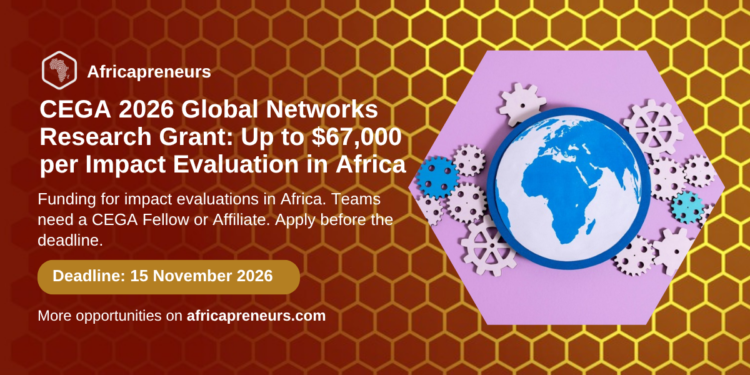
The Center for Effective Global Action (CEGA) at UC Berkeley is inviting joint proposals for policy- or programmatically relevant impact evaluations in East and West Africa, with a submission deadline of 15 November 2026. Up to $200,000 is available for 3 to 4 projects, with a maximum of $67,000 per project. Teams must include a CEGA Fellow and a CEGA Affiliate, so check that requirement before you start.
At a glance
| Deadline | 15 November 2026 (no time or time zone stated) |
| Funding | $200,000 in total for 3 to 4 projects, up to $67,000 per project |
| Focus | Impact evaluations with policy or programme relevance in East and West Africa |
| Who can apply | Teams that include at least one CEGA Fellow and one CEGA Affiliate |
| Period of performance | 15 May 2027 to 1 October 2028 |
| Notification | 19 January 2027 |
| Cost to apply | No fee mentioned on the official page |
| Official page | CEGA 2026 request for proposals |
Who can apply
The call is run by CEGA through its Global Networks programme, with The William and Flora Hewlett Foundation listed as a partner. CEGA sets these conditions:
- Teams must include at least one CEGA Fellow and at least one CEGA Affiliate.
- PhD students may apply if a CEGA Affiliate sponsors the study.
- Research must take place in Benin, Burundi, Côte d’Ivoire, Ethiopia, Ghana, Kenya, Madagascar, Malawi, Mali, Nigeria, Rwanda, Sierra Leone, Tanzania, The Gambia, Togo, Uganda, Zambia or Zimbabwe.
- Applications must be in English.
- Studies need a rigorous design that can identify causal effects and a feasible implementation plan. CEGA states that purely qualitative or descriptive studies are not eligible.
What you get
CEGA plans to award $200,000 in total to 3 to 4 projects, up to $67,000 each. Priority may go to extensions of CEGA-funded pilot grants. The subaward process runs from the end of January to April 2027, and the period of performance is 15 May 2027 to 1 October 2028.
How to apply
- Read the official request for proposals and the Global Networks Co-Authorship Statement it references.
- Form a team with a CEGA Fellow and a CEGA Affiliate. If you need a collaborator, send Namita Karnik a short concept note and two or three suggested faculty, NGOs or policymakers. CEGA says matches are not guaranteed.
- Prepare a research proposal adapted from the template (maximum 7 pages including the cover sheet), a budget narrative, and a completed budget in the Excel sheet provided. Letters of support from partners are encouraged but not required.
- Submit through the Submittable portal by 15 November 2026.
Advice from the Africapreneurs team
- Secure your CEGA Fellow and Affiliate first. Without both on the team, the proposal is not eligible, and CEGA does not guarantee matchmaking.
- Confirm that your study country is on the list of 18. If you work in Francophone West Africa, note that Benin, Côte d’Ivoire, Mali and Togo are included.
- Frame the design around causal identification. CEGA rules out purely qualitative or descriptive studies.
- If you already hold a CEGA pilot grant, say how the new proposal extends it, because CEGA says priority may go to extensions.
- Name your file as instructed: Proposal, the first three words of the title, and the study country.
FAQ
Can I apply without a CEGA Fellow or Affiliate?
No. Teams must include at least one Fellow and one Affiliate. PhD students may apply if a CEGA Affiliate sponsors the study.
Is there an application fee?
The official page mentions none.
Can I submit in French?
No. CEGA states that applications must be in English.
When will I hear back?
CEGA lists notification for 19 January 2027.