
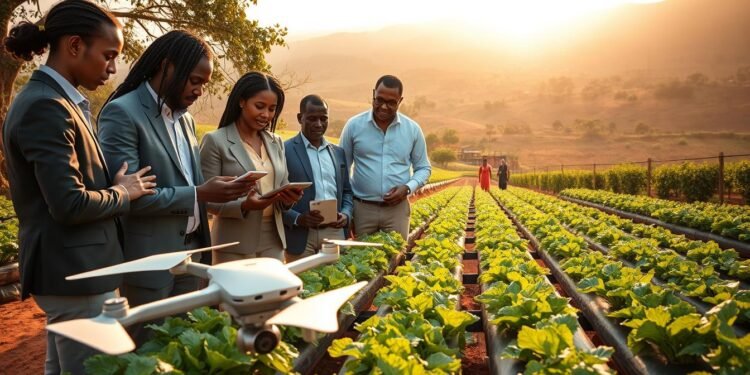
What if the key to solving Africa’s food security challenges isn’t just more land or water, but smarter technology?
The landscape of the continent’s primary economic sector has been fundamentally altered over the past few years. A wave of digital innovation is modernizing traditional practices.
This transformation is a collective effort. It integrates digital tools and new business models to build a more resilient framework for the future.
Industry experts now project the total value of the agritech industry will reach a staggering $1 trillion by the year 2030. This growth attracts significant attention and investment from global partners.
Stakeholders are closely watching. The focus remains on creating a stable and prosperous future through technological advancement in agriculture.
Key Takeaways
- The continent’s farming sector has undergone a significant digital transformation.
- Modernization efforts combine technology with new business approaches.
- The agritech sector is on a path to reach a $1 trillion valuation by 2030.
- A primary goal is enhancing food security for a growing population.
- This progress is building a more resilient economic framework.
- Global investors and development partners are increasingly engaged.
- Innovation is seen as crucial for future prosperity and stability.
Introduction: The Rise of Agricultural Innovation in Africa
Transformation in the cultivation landscape did not happen overnight. It is the result of a gradual fusion of tradition and technology.
Historical Evolution of Farming in Africa
Traditional farming methods have changed a lot in recent years. New tools now boost efficiency and output.
A recent report confirms this shift. It shows East and South Africa leading the change with new tech ventures.
Modern Trends Transforming the Sector
The current trend is a big move toward data-driven choices. This shift helps modernize the entire sector.
These modern methods are crucial. They help meet rising food needs and cut down on annual losses.
Key Factors Driving Agritech Advancements
The leap forward in cultivation practices hinges on two key technological pillars: connectivity and computation. These tools are reshaping how farms operate from the ground up.
Digital Technologies and Internet of Things Integration
Connected sensors in fields and on equipment form a digital nervous system. This Internet of Things (IoT) setup tracks soil moisture, crop health, and equipment status in real time.
The gathered information is used to advise growers on investments and financing. This integration is a cornerstone for modern agritech companies seeking optimal efficiency.
Data Analytics and Artificial Intelligence in Farming
Raw information becomes powerful insight through analytics. Artificial intelligence processes this data to predict weather impacts and ideal planting times.
These smart systems automate complex tasks, reducing manual labor. They provide precise recommendations that directly improve harvest quality and farm resilience.
African agri startups Shaping Nigeria’s Agricultural Future
Innovation hubs in Nigeria are focusing on a critical mission. They aim to empower the backbone of the nation’s food system with modern solutions.
Visionary local founders are at the forefront of this change. For instance, Miftaudeen Raji and Ayo Arikawe established AgroMall in 2016.
Their goal was to digitize the entire agriculture value chain. This work directly supports rural communities.
Empowering Small-Scale Farmers with Innovation
These new ventures place tools and knowledge directly into the hands of small-scale farmers. Access to vital resources and real-time market information is now simpler.
The focus is on practical support. Farmers receive what they need to improve their harvests and secure fairer prices for their goods.
Enhancing Productivity through Digital Platforms
A single digital platform can connect a grower to buyers, financiers, and suppliers. This creates a more transparent and efficient system for everyone.
By streamlining these connections, total food crop production rises across the country. It bridges the gap between rural producers and city consumers.
This empowers small-scale farmers and builds a more resilient food network for all farmers.
Spotlight on Leading Agri Startups and Their Innovative Solutions
The impact of digital innovation is most visible in the practical solutions offered by a new generation of enterprises. These organizations tackle specific challenges faced by rural producers.
Hello Tractor: Transforming Tractor Access and Farm Machinery Sharing
Jehiel Oliver founded this startup in 2014 to address a critical need. It provides a shared hiring model for machinery, giving smallholders affordable access to equipment.
AgroMall: Digitizing the Agriculture Value Chain
Established in 2016, this company offers a suite of essential services. Its platform uses AI-powered recommendations and market linkage to streamline the entire value chain for growers.
Apollo Agriculture: Optimizing Crop Production and Financial Inclusion
This leading venture helps producers increase their harvests. It provides precise guidance on seed selection and fertilizer, plus connects them to vital financial inputs.
These companies are revolutionizing the industry with targeted solutions. They ensure food production remains a viable business for millions of farmers.
Leveraging Technology for Enhanced Farm Productivity
Real-time monitoring and data-driven insights are revolutionizing how producers manage their land. This shift moves beyond basic tools. It integrates a suite of digital solutions directly into daily operations.
The goal is clear: to boost output and resilience. Modern technology provides the means to achieve it efficiently.
IoT, Fintech, and AI: Tools for Smarter Farming
The application of IoT sensors and fintech tools is essential. They allow farmers to monitor soil and crop health instantly.
This constant stream of data supports informed choices. These decisions directly improve the quality of products for consumers.
These technological services simplify complex tasks. They make modern farming more manageable for every farm operator.
Producers can learn about the latest advances at events like the 9th Africa Agri Expo. It will be held in Nairobi, Kenya, in February 2026.
As more farmers adopt these tools, the entire sector’s value rises. This benefits both rural communities and the broader economy.
KHULA and the Future of Online Agricultural Marketplaces
A Johannesburg-based venture is pioneering a new model for farm trade. Founded in 2016, this company has quickly become a leader in its field.
It connects rural producers directly with urban buyers through a digital system. This approach is reshaping commerce in the sector.
Key Features, Funding, and Competitive Advantage
The company KHULA has secured $9.44 million in total funding. This capital supports the expansion of its core platform.
Growers use this digital tool to list their products for sale. They also gain access to vital inputs like seeds and fertilizer.
This dual function simplifies daily operations. It lets farmers concentrate on their core production activities.
With a Tracxn score of 53/100, KHULA ranks first among its peers. Its competitive advantage lies in bridging the gap between producers and consumers.
The platform creates a more transparent and efficient market. It ensures fairer prices and reliable supply chains.
As a top performer in South Africa, it sets a high standard. It shows how technology can add value to the entire industry.
Conclusion
As this digital evolution matures, its lasting impact on food production and farmer livelihoods becomes increasingly apparent. The integration of smart tools into the farming process is a proven strategy for boosting output.
Innovative business models place rural producers at the center. This focus helps ensure growing essential food crops remains a sustainable venture for the long term.
The sector’s growth hinges on reliable access to vital services and timely information. When farmers connect to markets and data-driven advice, the entire value chain strengthens.
Supporting these digital solutions is crucial for achieving broader food security. The future is being rewritten with technology empowering every link from seed to consumer.