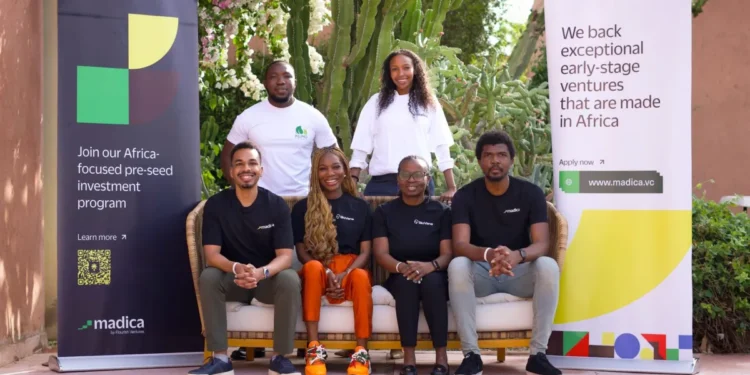
Africa’s early-stage innovation ecosystem has received another meaningful boost. Madica, the pre-seed investment platform focused on backing underrepresented and underfunded founders, has added three new startups to its portfolio: Tanzania’s Kilimo Fresh, Kenya’s Hakimu, and Nigeria’s Biovana. The new round brings a total of up to $600,000 in fresh capital, with each company eligible for as much as $200,000 alongside structured venture-building support.
The announcement matters for more than the headline funding number. Madica was launched in 2022 as a sector-agnostic, Africa-focused pre-seed program affiliated with Flourish Ventures. Its model goes beyond writing checks. The platform is designed to close persistent gaps in African startup funding by giving founders access to mentorship, company-building support, and investor networks that are often available only to the most connected entrepreneurs.
Why This Madica Investment Stands Out
Pre-seed funding in Africa remains difficult to secure, especially for founders outside the continent’s most heavily funded markets or sectors. That is why Madica’s approach continues to attract attention. The program is built specifically for mission-driven startups that already show early traction but still need structured help to sharpen operations, validate growth, and prepare for follow-on capital. In practice, that means Madica is not just funding companies; it is helping shape investment-ready businesses.
Each of the three newly backed startups will enter Madica’s 18-month support program. That package includes a personalized curriculum, hands-on mentorship, executive coaching, and two fully funded immersion trips to important technology ecosystems in Africa and abroad. Madica also connects portfolio companies to its global investor network, giving founders a stronger path toward future fundraising and long-term scale.
Kilimo Fresh: Building a Smarter Agritech Supply Chain in Tanzania
Kilimo Fresh is solving a problem that affects both farmers and food buyers across urban Africa: an inefficient produce supply chain. Madica describes the company as a technology-enabled social enterprise that aggregates fresh produce from smallholder farmers and supplies B2B customers as well as thousands of informal retailers in Dar es Salaam. By cleaning, sorting, packaging, and distributing produce more efficiently, the startup helps reduce waste and lower costs across the value chain.
The company’s impact model is especially compelling because it addresses multiple pain points at once. According to Madica, Kilimo Fresh offers farmers more stable pricing, direct access to urban markets, and reduced losses through cold-chain and cold-storage systems. Madica also says the business has been able to offer farmers prices roughly 20% higher than those typically offered by middlemen, while helping customers secure produce more reliably. That kind of operational efficiency makes Kilimo Fresh a notable agritech startup to watch in East Africa.
Hakimu: Expanding Access to Legal Infrastructure Through AI
Hakimu represents another major theme in African innovation: the use of artificial intelligence to unlock fragmented institutional systems. Madica says the Kenyan startup is building Africa’s first multilingual AI-powered legal search engine. Its platform aggregates and structures laws and case law from across the continent, making it easier for governments, lawyers, businesses, and investors to access reliable legal information across jurisdictions.
That mission gives Hakimu relevance far beyond the legal profession. In many African markets, legal data is difficult to discover, expensive to navigate, or unevenly digitized. By creating a searchable and structured legal intelligence layer, Hakimu could reduce friction for compliance, business expansion, investment due diligence, and policy interpretation. In other words, this is not just a legaltech play; it is infrastructure for a more transparent and accessible business environment. That broader value proposition likely explains why it fits Madica’s portfolio strategy so well.
Biovana: Unlocking African Health Data for Research and Precision Medicine
Biovana, the Nigerian startup in the new cohort, addresses one of the most important and underdeveloped areas in African innovation: health-data infrastructure. Madica describes Biovana as a company building national health-data systems across Africa by harmonizing biobank, registry, and clinical datasets into research-ready assets that can support discovery, innovation, and precision medicine.
This focus could prove highly strategic. Clean, credible, and interoperable health datasets are essential for pharmaceutical research, clinical studies, and AI-driven medical innovation. Yet health data across many African systems remains fragmented or difficult to standardize. Biovana’s model aims to turn that complexity into usable infrastructure, which may help increase the continent’s visibility in global research and improve the quality of locally relevant health innovation. Madica’s backing suggests strong conviction that health-data platforms will become increasingly important as biotech and AI applications expand.
What This Means for African Startup Funding
With these three additions, Madica’s portfolio has grown from 10 backed startups to 13. The expansion continues a pattern the firm has followed since launch: support founders working in overlooked markets, underserved sectors, and structurally difficult environments. Previous Madica communications have emphasized geographic and founder diversity as central to the portfolio strategy, and this latest round continues that direction with investments spanning Tanzania, Kenya, and Nigeria across agritech, legaltech, and biotech.
That diversity is significant because it reflects a more mature view of African venture building. Instead of clustering around a narrow set of trendy categories, Madica is spreading capital across industries that solve real operational problems: food distribution, legal accessibility, and health-data infrastructure. This suggests a portfolio philosophy centered on durable systems value rather than short-term hype. That is an inference from the sectors and company descriptions Madica has published, but it is a strong one.
Madica’s head, Emmanuel Adegboye, has repeatedly framed the platform as a long-term partner for early founders rather than a passive source of capital. That positioning matters in the African pre-seed market, where founder support often becomes as valuable as funding itself. The combination of capital, mentorship, immersion trips, and investor access gives startups a stronger chance to survive the difficult transition from promising idea to scalable business.
The Bigger Picture
The latest Madica investment round sends a clear signal: investors are still willing to back African startups that tackle fundamental market inefficiencies with focused, technology-driven solutions. Kilimo Fresh is modernizing fresh-produce distribution, Hakimu is digitizing and democratizing legal access, and Biovana is building trusted health-data rails for research and innovation. Together, they reflect the breadth of opportunity still available at the pre-seed stage across the continent.
For founders, operators, and investors watching the African tech ecosystem, this deal is a reminder that strong venture outcomes often begin with targeted support at the earliest stage. Madica’s latest $600,000 deployment may be modest by global funding standards, but its strategic importance is much larger. It reinforces the idea that the next generation of African category leaders may emerge from founders who receive the right guidance, network access, and operating support before the market fully notices them.