
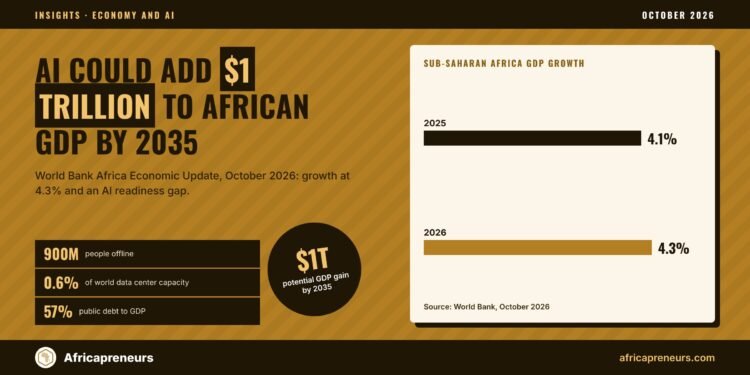
Sub-Saharan Africa’s economy is projected to grow 4.3% in 2026, up from 4.1% in 2025, and full adoption of artificial intelligence could add $1 trillion to the region’s GDP by 2035, according to the World Bank’s Africa Economic Update, October 2026: Building AI Readiness, released on 6 October 2026. The report finds that most of the region is not yet ready to capture that gain.
For African founders and investors, the report is both a macro outlook and a map of where the AI gaps are: connectivity, computing capacity, local language data and skills.
About the report
| Publisher | World Bank, Africa Region Chief Economist Office |
| Released | 6 October 2026 |
| Title | Africa Economic Update, October 2026: Building AI Readiness (formerly Africa’s Pulse) |
| Data covered | Sub-Saharan Africa growth, inflation and debt outlook, and AI adoption data up to Q1 2026 |
| Latest edition? | Yes, as of November 2026. The report is published twice a year. |
Key findings
- Regional growth is projected to rise from 4.1% in 2025 to 4.3% in 2026, with median inflation at 5.5% and public debt at about 57% of GDP, according to the World Bank.
- Use of generative AI ranged from 7.2% in Rwanda to 23.1% in South Africa in the first quarter of 2026, and 16 countries were below 10%, the report shows.
- About 900 million people in the region are offline. The region is home to 18% of the world’s population but only 0.6% of global data center capacity, and about 5% of its data centers are ready for AI workloads, according to the World Bank.
- African languages are close to absent from AI training data. Africa accounts for about 2% of global AI training data, and Swahili has 710 datasets against 88,844 for English, the report finds.
- AI is more likely to augment African jobs than replace them. The World Bank estimates automation risk at 2.6%, against 14.2% in high-income economies, and augmentation potential at 15.2%.
- Full activation of AI could add $1 trillion to GDP and 35 to 40 million digital jobs by 2035. At current levels of preparedness, the gain would be 0.2% to 4% of cumulative GDP, according to the report.
The main figures at a glance:
| Indicator | Value |
|---|---|
| GDP growth, 2025 to 2026 | 4.1% to 4.3% |
| Median inflation | 5.5% |
| Public debt | About 57% of GDP |
| Generative AI use, Q1 2026 | 7.2% (Rwanda) to 23.1% (South Africa) |
| Share of world population vs data center capacity | 18% vs 0.6% |
| Potential GDP gain from full AI activation by 2035 | $1 trillion |
What the report means for African founders and investors
- The macro picture is steady, not easy. Growth above 4% helps demand, but debt near 57% of GDP limits public spending. Ventures that depend on government contracts should plan for slow payment cycles.
- Infrastructure is the bottleneck. With 0.6% of global data center capacity, compute, cloud and connectivity are business opportunities in their own right, not only constraints.
- Local language data is an open field. The gap between Swahili and English datasets shows how little African language content exists. Startups that build local data and models address a gap the World Bank names directly.
- Augmentation sells better than replacement. With low automation risk and higher augmentation potential, tools that make existing workers more productive fit African labor markets better than tools that cut jobs.
📥 Download the full report
The World Bank publishes the full report free of charge under an open licence. The report is published by the World Bank, not by Africapreneurs.
FAQ
4.3%, up from 4.1% in 2025, according to the World Bank’s Africa Economic Update, October 2026.
Full activation of AI could add $1 trillion to GDP and 35 to 40 million digital jobs by 2035. At current preparedness, the gain is 0.2% to 4% of cumulative GDP.
Use ranged from 7.2% in Rwanda to 23.1% in South Africa in Q1 2026, and 16 countries were below 10%.
The World Bank estimates automation risk at 2.6%, against 14.2% in high-income economies, and augmentation potential at 15.2%. AI is more likely to change jobs than remove them.
Africa’s Pulse was the previous name of the World Bank’s twice-yearly economic update for Sub-Saharan Africa, now called the Africa Economic Update.
Sources
- World Bank: Africa Economic Update, publication page
- World Bank: Africa Economic Update, October 2026: Building AI Readiness (PDF)