If we are building an agrifood startup with real ambition, the Global Impact Challenge application is one of those opportunities that deserves a serious look. It is not just another startup form hiding behind big promises. It is part of THRIVE’s broader global effort to find scalable solutions for the biggest food and agriculture problems on the planet, then put those founders in front of investors, corporate partners, and decision-makers who can actually move the needle.
The current challenge is tied to the 2026 cycle, with THRIVE presenting it as a global search for startups solving urgent agrifood problems and offering finalists a path to pitch live in Silicon Valley.
What Is the Global Impact Challenge Application?
At its core, this application is the front door to the THRIVE Global Impact Challenge 2026. THRIVE describes the challenge as a worldwide search for startups developing breakthrough solutions across the agrifood value chain.
In plain English, that means the program is hunting for founders who are not just building interesting tools, but creating practical answers to real-world problems like climate resilience, food security, resource efficiency, and sustainable production. The winning startup can compete for up to $1 million in investment from SVG Ventures, while finalists get the chance to pitch on stage at the THRIVE Global Impact Summit in Silicon Valley.
Who Is Behind the Program?
The challenge is led by SVG Ventures|THRIVE, which positions itself as a Silicon Valley-based agrifood innovation and investment platform connecting startups, corporates, investors, governments, and research partners. THRIVE’s own platform materials emphasize that it offers more than capital, pairing venture development with market access, global partnerships, and sector expertise. That matters because a strong startup does not grow on funding alone. Capital is fuel, yes, but networks are often the engine.
How the Global Impact Challenge Fits the Bigger THRIVE Mission
THRIVE frames the Global Impact Challenge as one pillar of its broader Global Impact Initiative, a 10-year effort launched in 2020 to support a more sustainable, resilient, and climate-positive food and agriculture system. The other pillars include industry roundtables and the Global Impact Summit itself. So this application is not floating in isolation; it sits inside a larger ecosystem designed to create partnerships, visibility, and momentum for startups that can deliver measurable impact.
Why This Challenge Matters in 2026
Food and agriculture are standing at a crossroads. Climate pressure is rising. Resource constraints are tightening. Food systems are under stress. THRIVE’s 2026 materials frame the challenge around exactly that tension: the future of food systems depends on bold, scalable innovation that can improve resilience, sustainability, and equitable access. That framing is important because it tells us what the judges are really looking for. They are not just asking, “Is this clever?” They are asking, “Can this work at scale, and does it matter in the real world?”
What Startups Can Actually Gain
The headline prize is easy to remember: up to $1 million in investment from SVG Ventures. But the smarter founders will notice the second layer of value. Finalists also receive global visibility, direct access to corporate partners and investors, pitch coaching, VIP networking access, exposure during virtual pitch days, and a startup showcase booth at the summit. That bundle is powerful because in agrifood, traction often comes from introductions, pilots, partnerships, and distribution channels as much as from cash.
Why the Summit Opportunity Is a Big Deal
THRIVE says top startups from the challenge themes will pitch live at the THRIVE Global Impact Summit in Silicon Valley. The summit is presented as a major leadership forum for agrifood and climate innovation, bringing together CEOs, investors, policymakers, corporates, and entrepreneurs. In other words, the stage is not just symbolic. It is a marketplace of influence. For an early-stage startup, that kind of room can be like stepping out of a small rehearsal studio and suddenly performing under stadium lights.
The Six 2026 Challenge Themes
THRIVE’s current 2026 challenge is organized around six themes, and applicants are expected to align with one or more of them. These are not random buckets. They act like the map legends for the kind of innovation THRIVE wants to surface.
Regenerative Agriculture
This theme is about restoring and strengthening natural systems while keeping agriculture productive. If a startup improves soil health, biodiversity, carbon outcomes, or input efficiency, this is likely the home base.
Artificial Intelligence & Automation
This area covers tools that help agriculture and food systems become smarter and more efficient through data, machine learning, robotics, automation, or decision support.
Animal Health & Nutrition
This theme targets innovations that improve livestock health, welfare, productivity, nutrition, and resilience.
Climate Resilience
In the 2026 cycle, THRIVE uses “Climate Resilience” as a core theme. That is a meaningful shift in language because it highlights adaptation as well as mitigation. Startups that help farmers, supply chains, or food systems handle volatility may fit especially well here.
Water & Waste Management
This category focuses on resource efficiency, treatment, reuse, reduction of waste, and better environmental outcomes across operations and supply chains.
Food Security & Nutrition
This theme points toward solutions that help feed more people, improve quality and access, reduce vulnerability, and strengthen the health of food systems.
Who Should Apply?
The official selection criteria make the basic target profile pretty clear. THRIVE is looking for early-stage startups or entrepreneurs at the Seed to Series A stage. The program is open globally, and applicants are expected to show clear alignment with at least one challenge theme. Just as important, they need to demonstrate proven climate or environmental impact through measurable outcomes such as sustainability gains, carbon reduction, biodiversity, or resource efficiency.
Stage Matters, but So Does Readiness
Seed to Series A does not just describe funding stage. It hints at maturity. The startup should be early enough to benefit from acceleration, but developed enough to show real traction, credibility, or at least a believable path to scale. THRIVE is not asking for a napkin sketch. It is asking for something that can survive contact with reality.
Global Applicants Are Welcome
The official criteria explicitly invite applications from around the world. That global openness matters because many agrifood problems are local in expression but global in importance. A water-efficiency solution in North Africa, a resilience platform in Latin America, or an animal-health innovation in Southeast Asia can all be relevant if the model is scalable and the impact case is strong.
What the Application Form Appears to Ask For
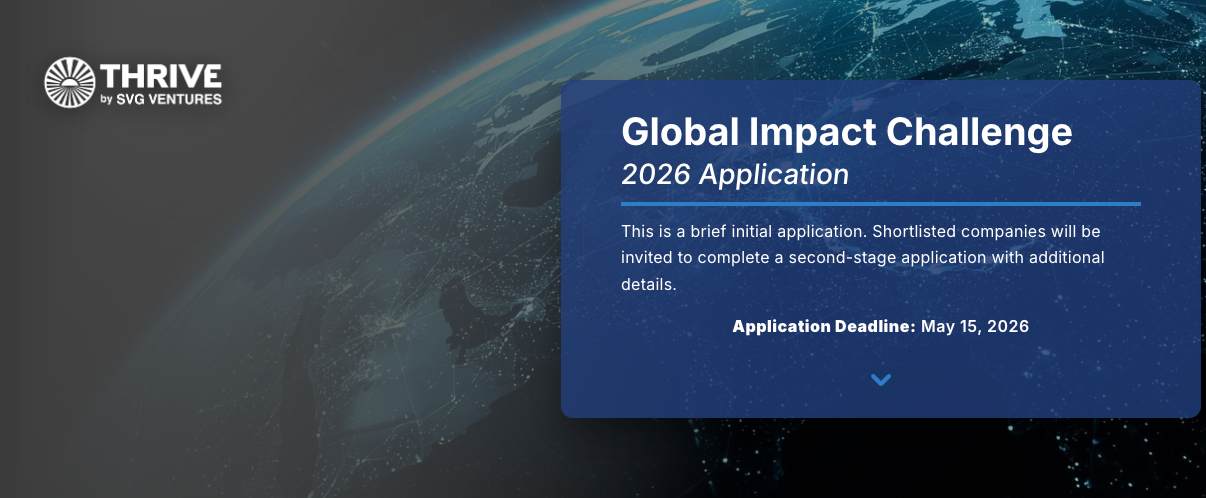
The application portal itself is a short initial application, and at least one listing notes that shortlisted companies may later be invited to complete a second-stage submission with more detail. Search snippets for the live application page show the form asking for core company and contact information such as company name, website, year founded, headquarters country, primary contact name, title, and email. That is a useful signal: the first step is meant to open the door, not drown founders in paperwork.
Why a Short First Application Can Work in Your Favor
A short application sounds easy, but it creates its own challenge. When the form is brief, every sentence carries more weight. There is no room to hide behind jargon, no extra pages to rescue a weak core story. We have to be sharp, specific, and memorable fast.
The 2026 Timeline We Need to Watch
THRIVE’s official 2026 challenge page lays out the timeline clearly: applications opened on February 23, applications close on May 15, application review happens in June, virtual pitch days are set for June 24 and 25, finalist selection runs from July through September, and the live summit pitch takes place on October 15. The associated summit event page lists the overall summit dates as October 14 and 15, 2026, in Silicon Valley at the Marriott Santa Clara, California.
Applications Open
February 23, 2026.
Applications Close
May 15, 2026 on the official THRIVE page.
Application Review
June 2026.
Virtual Pitch Days
June 24–25, 2026.
Finalist Selection
July through September 2026.
Live Pitch at the Summit
October 15, 2026, during the summit window in Silicon Valley.
A Quick Note on the Deadline Confusion
Here is one detail worth handling carefully: a third-party VC4A listing shows the challenge as closing on May 30, 2026, while THRIVE’s official challenge page lists May 15. When official and third-party pages disagree, we should trust the official source first and verify on the application portal before submitting. In startup terms, this is the administrative version of “measure twice, cut once.”
What Happens After You Submit
The program flow suggests a funnel rather than a one-shot contest. First comes the initial application. Then comes review. Then selected startups move into virtual pitch days and later finalist selection before the live summit pitch. That structure tells us something useful: the application is not the finish line. It is the audition for later conversations, deeper diligence, and higher-stakes visibility.
How to Position Your Startup So It Fits
A strong application usually does three things at once.
- It explains the problem in concrete language.
- It proves why the solution is different and scalable.
- It connects the business model to measurable impact.
That is not guesswork. It mirrors THRIVE’s published criteria around innovation, scalability, theme alignment, and demonstrated environmental or climate impact. If the application reads like a mission statement without evidence, it will likely feel thin. If it reads like a technical report without a compelling business case, it may feel incomplete. The sweet spot is where mission, market, and momentum all meet.
What Judges Are Likely Trying to See
Based on the official criteria, judges are likely screening for several practical signals:
- Is the startup genuinely early-stage but investable?
- Does it fit one or more challenge themes clearly?
- Can the team show measurable impact, not vague aspiration?
- Is there a believable path to growth, partnerships, or adoption?
- Will this startup be compelling on a global stage?
That last point matters more than many founders think. A summit pitch is not just about science or technology. It is also about story, clarity, commercial logic, and confidence.
How We Would Strengthen the Application Before Hitting Submit
Lead With the Outcome, Not the Feature
Founders often open with what they built instead of what changes because it exists. That is backwards. THRIVE’s framing is impact-first, so the application should show the outcome first: lower waste, stronger resilience, improved efficiency, reduced emissions, better nutrition, healthier animals, or more secure yields.
Quantify What You Can
If there is traction, name it. Pilot results, acreage served, cost reduction, yield improvement, water saved, emissions reduced, customer retention, or revenue growth all make the story heavier in the best possible way.
Name the Theme Clearly
Do not force the reviewer to guess your category. Spell it out. If the startup sits across two themes, explain the primary one and the secondary one.
Show Why Now
Timing can be as important as technology. Why is the market ready? Why is the problem urgent? Why can your team win now, not someday?
Common Mistakes That Could Weaken an Otherwise Good Application
Mistake 1: Writing Like a Brochure
Applications are not ad copy. If every sentence says “revolutionary,” “disruptive,” and “game-changing,” the real signal gets buried.
Mistake 2: Forgetting Measurable Impact
THRIVE explicitly asks for climate or environmental impact. If we cannot show real outcomes or at least a credible measurement framework, the application may feel incomplete.
Mistake 3: Being Too Broad
Trying to solve every problem at once usually weakens the story. Strong applications feel focused. They know their lane.
Mistake 4: Ignoring Commercial Reality
A brilliant technology without a path to adoption can sound like a lab result searching for a market. THRIVE’s ecosystem is commercial and partnership-oriented, so the business case matters.
Why This Opportunity Is Bigger Than a Competition
The easiest way to misunderstand the Global Impact Challenge is to treat it as just a prize. THRIVE itself says it is more than a pitch competition and instead a platform to accelerate partnerships, capital, and global expansion. That difference is huge. A one-off contest gives applause. A well-structured platform can give momentum. And for founders solving hard agrifood problems, momentum is often the scarcest resource of all.
Should Early-Stage Founders Apply Even If They Are Not “Perfect” Yet?
In many cases, yes. The published criteria are designed for Seed to Series A companies, not only polished later-stage ventures. That means founders do not need to be giants already. They do, however, need to show seriousness, evidence, and scalability. Think of it like entering a demanding expedition. You do not need to have crossed every mountain before, but you do need the right equipment, a believable route, and proof that you can keep climbing.
Our Final Take on the Global Impact Challenge Application
If a startup is building a meaningful agrifood solution and can connect innovation to measurable impact, the Global Impact Challenge application is a high-value opportunity. The official 2026 materials show a program with a clear timeline, defined themes, global eligibility, strong visibility, and real upside through investment and ecosystem access. For the right founder, this is not just another form to fill out. It is a chance to step into a serious global conversation about the future of food and agriculture.
Conclusion
The Global Impact Challenge application deserves attention because it sits at the intersection of purpose, capital, and scale. THRIVE is not merely asking founders to dream bigger; it is asking them to prove they can build solutions that matter in the real world. That is what makes this opportunity so compelling. If we have a startup that aligns with the challenge themes, shows measurable impact, and is ready to speak clearly about growth, this application can become more than an entry form. It can become the bridge between a promising startup and a much larger stage.
FAQs
1. Is the Global Impact Challenge open to startups outside the United States?
Yes. THRIVE’s official selection criteria say applicants from around the world are encouraged to apply, and other listings describe the challenge as globally open.
2. What stage should a startup be at before applying?
The official criteria state the challenge is aimed at early-stage startups or entrepreneurs from Seed to Series A.
3. Does a startup need to show climate or environmental impact?
Yes. THRIVE explicitly says applicants should demonstrate clear climate or environmental impact with measurable outcomes such as sustainability gains, carbon reduction, biodiversity, or resource efficiency.
4. What do finalists receive besides the chance to win investment?
According to THRIVE, finalists get complimentary summit passes, VIP networking access, pitch coaching, direct exposure to partners and investors, a showcase booth, and global visibility at the summit.
5. What basic information does the first application seem to request?
Search snippets for the live application page show fields such as company name, website, year founded, headquarters country, and primary contact details. A related listing also says the first form is a brief initial application.