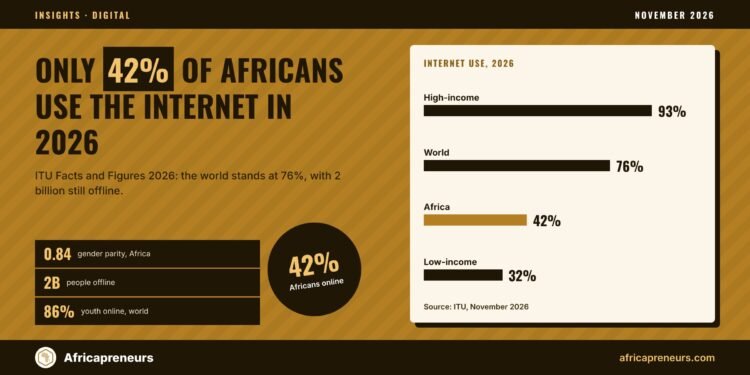
42% of people in Africa use the Internet in 2026, against 76% of the world’s population, according to the International Telecommunication Union’s Measuring digital development: Facts and Figures 2026, released on 3 November 2026. Africa remains the least connected region, which also makes it the largest growth market for digital businesses.
For African founders building online services, the figures size the market that is already reachable and the one still waiting to come online.
About the report
| Publisher | International Telecommunication Union (ITU) |
| Released | 3 November 2026 |
| Title | Measuring digital development: Facts and Figures 2026 |
| Data covered | 2026 estimates of Internet use, gender and youth gaps, coverage and mobile ownership, by region and income group |
| Latest edition? | Yes, as of November 2026. Published every year. |
Key findings
- 42% of people in Africa use the Internet in 2026, the lowest rate of any region, according to ITU.
- Worldwide, 6.3 billion people, or 76% of the population, are online, up from 6.1 billion (74%) in 2025, and about 2 billion remain offline.
- Internet use reaches 93% in high-income countries but only 32% in low-income countries, ITU finds.
- Africa’s gender parity score for Internet use rose to 0.84 in 2026, from 0.72 in 2019, according to ITU. Globally, 79% of men and 74% of women are online.
- 86% of people aged 15 to 24 use the Internet worldwide, compared with 74% of the rest of the population.
- Mobile phone ownership is higher than Internet use in most countries, the report notes, which means many people own a device but do not yet go online.
Internet use by region and income group in 2026, according to ITU:
| Group | Share of people online |
|---|---|
| High-income countries | 93% |
| World | 76% |
| Africa | 42% |
| Low-income countries | 32% |
What the report means for African founders
- The next users are still to come. With 42% online, most Africans are not yet Internet users. Products that work on basic phones, low data and local languages reach the people who will come online next.
- Devices are ahead of usage. Since phone ownership exceeds Internet use, the gap is often cost, skills or relevant content rather than hardware. Affordable data bundles, digital skills and useful local services address it.
- Women are coming online fast. Africa’s parity score rose from 0.72 to 0.84 in seven years. Services designed for women users, from payments to learning, address a growing segment.
- Youth lead adoption. With young people far more connected than the rest of the population, Africa’s young demographics are an advantage for digital ventures.
For the AI side of the same picture, see our summary of the World Bank’s Africa Economic Update, October 2026.
📥 Read the full report
ITU publishes Facts and Figures 2026 free of charge online. The report is published by ITU, not by Africapreneurs.
FAQ
42%, against 76% worldwide, according to ITU’s Facts and Figures 2026.
About 2 billion people worldwide, while 6.3 billion are online.
Yes. Africa’s gender parity score rose to 0.84 in 2026, from 0.72 in 2019.
The International Telecommunication Union (ITU), the UN agency for information and communication technologies, every year.
Sources
- ITU: Measuring digital development, Facts and Figures 2026
- ITU: Internet use
- ITU: The gender digital divide