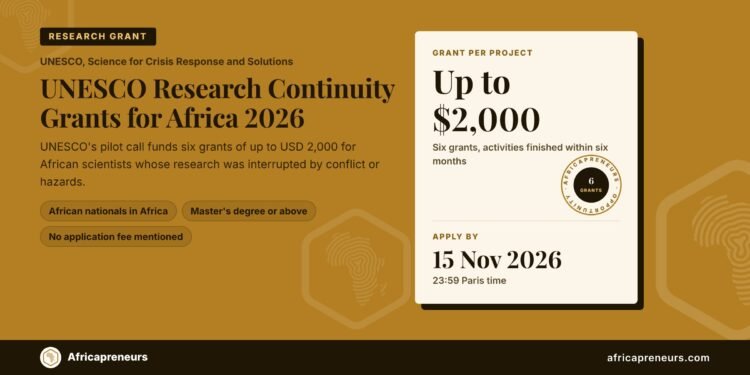
UNESCO’s Science for Crisis Response and Solutions (SCRS) programme is offering six institutional grants of up to USD 2,000 each to African scientists whose research was interrupted by armed conflict or by a natural or biological hazard. Applications close on 15 November 2026 at 23:59 Paris time. This is a pilot call, and the funded activities must be finished within six months.
For researchers who are building science-based ventures or working in university labs across Africa, the call is a small but concrete way to restart fieldwork, lab work or data collection that a crisis stopped. It is a research continuity grant, not a startup grant, and your host institution has to back the application.
At a glance
| Deadline | 15 November 2026, 23:59 Paris time |
| Who can apply | African nationals based at a recognized university or research institute in Africa, with at least a Master’s degree |
| Grant | Up to USD 2,000 each, six grants in the pilot call |
| Duration | Activities completed within six months |
| Subject | Natural-science research, including interdisciplinary work with a substantial natural-science component |
| Cost to apply | No application fee is mentioned on UNESCO’s page |
| Official page | UNESCO call for applications |
Who can apply?
UNESCO sets out the following requirements for applicants:
- You are an African national based at a recognized university or research institute in Africa.
- You hold at least a Master’s degree or an equivalent recognized research qualification.
- Your research is in the natural sciences, or is interdisciplinary with a substantial natural-science component.
- Your research was interrupted by armed conflict or by a natural or biological hazard within the previous three years, or is still materially affected by it.
- You provide a signed support letter from your host institution.
- You confirm that the same costs are not funded from another source.
UNESCO says it particularly encourages women scientists, researchers under 40, and researchers from least developed countries and Small Island Developing States in Africa.
What do the grants offer?
The pilot call funds six institutional grants of up to USD 2,000 each. The proposed activities must be completable within six months. The amount is a ceiling, so a smaller request is possible. UNESCO’s page does not describe other benefits for this call.
How to apply
- Read the call for applications, the terms of reference and the concept note on the UNESCO page.
- Complete and sign the application form, available in English or French.
- Attach your CV, proof of your highest relevant qualification and the signed institutional support letter, plus any ethics, research or fieldwork authorizations your project needs.
- Submit online through the official English application form before 15 November 2026, 23:59 Paris time.
Advice from the Africapreneurs team
- Show the interruption plainly. The call asks you to demonstrate that a conflict or hazard stopped your work in the last three years or still affects it. Dates, locations and what was lost belong in the application.
- Ask for the support letter now. A signed letter from your host institution is mandatory, and institutional sign-off is often the slowest step.
- Size the project to the money. With a ceiling of USD 2,000 and six months, a narrow, finishable task such as replacing equipment or restarting a data series fits better than a broad plan.
- Check the authorizations. If your work needs ethics or fieldwork permits, UNESCO expects them with the application.
FAQ
Is there an application fee?
UNESCO’s call page does not mention one.
Can I apply in French?
Yes. UNESCO provides the application form in English and in French.
Is the call open to social scientists or entrepreneurs?
The call covers natural-science research, including interdisciplinary work with a substantial natural-science component. Applicants must be African nationals based at a university or research institute in Africa.
Is USD 2,000 guaranteed?
No. UNESCO describes the grants as up to USD 2,000 each, and only six grants are planned in this pilot call.