By 2030, 87% of the world’s extremely poor are projected to live in Sub-Saharan Africa or in fragile and conflict-affected settings, according to the World Bank’s Poverty, Prosperity, and Planet Report 2026, released on 26 October 2026. The report’s answer is jobs: more of them, and better paid.
For African entrepreneurs, that makes job creation the center of the continent’s development agenda, and a measure that investors, governments and development partners will increasingly use.
About the report
| Publisher | World Bank |
| Released | 26 October 2026 |
| Title | Poverty, Prosperity, and Planet Report 2026: Jobs at the Center of Poverty Eradication |
| Data covered | Household survey data from more than 130 economies, with projections to 2030 and 2050 |
| Latest edition? | Yes, as of November 2026. Published every two years. |
Key findings
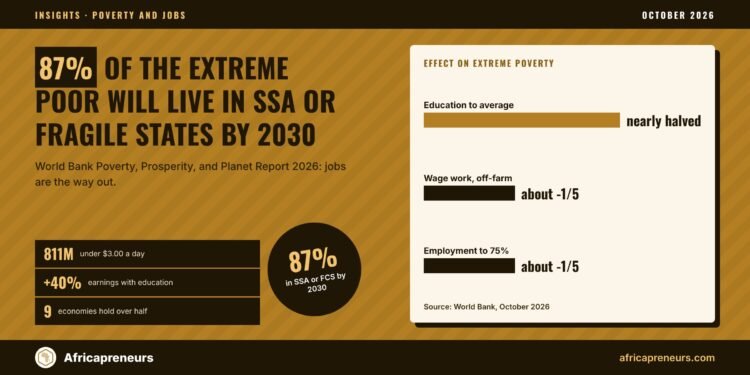
- 87% of the extremely poor are projected to live in Sub-Saharan Africa or fragile and conflict-affected settings by 2030, according to the World Bank.
- About 811 million people, 1 in 10 worldwide, live on less than $3.00 a day in 2026, essentially the same level as before the pandemic.
- More than half of the extremely poor live in just nine economies, the report finds.
- Moving into wage work or out of agriculture cuts poverty by about one-fifth, and raising employment among working-age adults in poor households to 75% would cut extreme poverty by about one-fifth, the World Bank estimates.
- Raising education to the average level lifts earnings by about 40% and nearly halves extreme poverty.
- Bringing extreme poverty down to 3% by 2050 would need per capita growth of about 4% a year, roughly twice the pace of the last 25 years, according to the report.
What moves households out of extreme poverty, according to the World Bank’s estimates:
| Change | Estimated effect |
|---|---|
| Move into wage work or out of agriculture | Poverty down about one-fifth |
| Employment of 75% among working-age adults in poor households | Extreme poverty down about one-fifth |
| Education raised to the average level | Earnings up about 40%, extreme poverty nearly halved |
What the report means for African entrepreneurs
- Every formal job counts. The World Bank finds that moving people into wage work is one of the fastest ways out of poverty. Businesses that hire, even at small scale, are part of the solution the report describes.
- Agri-business is a lever. Leaving low-productivity farming reduces poverty. Ventures that add processing, logistics or market access around agriculture help people move up without leaving rural areas.
- Skills pay. A 40% earnings gain from more education is a strong case for training, apprenticeships and edtech built for African labour markets.
- Expect jobs metrics from funders. With poverty concentrating in Africa, development finance will ask how many jobs a venture creates and for whom. Tracking this from the start makes fundraising easier.
For the wider economic picture, see our summary of the World Bank’s Africa Economic Update, October 2026.
📥 Download the full report
The World Bank publishes the full report, with country data and methodology, free of charge. The report is published by the World Bank, not by Africapreneurs.
FAQ
The World Bank projects that 87% will live in Sub-Saharan Africa or in fragile and conflict-affected settings.
About 811 million, or 1 in 10 people worldwide, live on less than $3.00 a day.
Moving into wage work or out of agriculture cuts poverty by about one-fifth, and raising employment in poor households to 75% would cut extreme poverty by about one-fifth.
Raising education to the average level lifts earnings by about 40% and nearly halves extreme poverty, according to the World Bank.
Sources
- World Bank: More and better jobs key to putting poverty reduction back on track, 26 October 2026
- World Bank: Poverty, Prosperity, and Planet Report 2026